As a parent, nothing tugs at your heartstrings quite like seeing your child doubt themselves. I still remember a Tuesday evening not too long ago. My seven-year-old was sitting at the kitchen table, tears streaming down her face, eraser crumbs scattered everywhere. She was trying to draw a horse for a school project, but it just wasn’t looking the way she pictured it in her head.
“I can’t do it,” she sobbed, pushing the paper away. “I’m just not good at anything.”
Ouch. Hearing those words from your own child is tough. My immediate instinct was to jump in, fix the drawing, and shower her with generic praise like, “You’re the best artist in the world!” But I stopped myself. I realized in that moment that true confidence building for kids isn’t about telling them they are perfect; it’s about teaching them that they are capable of handling imperfections and overcoming challenges.
If you are looking for real, actionable ways to nurture your child’s self-esteem, you are in the right place. Let’s talk about a few simple, everyday strategies that have completely transformed the vibe in our home.
1. Praise the Process, Not Just the Result
For a long time, my go-to phrase was, “You’re so smart!” or “That’s a beautiful painting!” While well-intentioned, this kind of praise can accidentally teach kids that their worth is tied only to the final product or their natural talent.
Instead, I started shifting my focus to their effort. When my daughter was struggling with that horse drawing, I sat down next to her and said, “I can see how hard you are working on this. It takes a lot of patience to keep trying when something is difficult.”
By praising her perseverance, she realized that the trying was the victory, not just the final drawing. This simple shift in language builds a “growth mindset,” helping them understand that skills are built through effort, not magic.
2. Give Them “Important” Household Jobs
Kids crave a sense of belonging and purpose. One of the best strategies for confidence building for kids is letting them contribute to the family in meaningful ways.
Last summer, I decided to hand over the responsibility of feeding our family dog to my youngest. At first, it was messy. Kibble ended up all over the floor. But instead of taking the job back, I handed him a small broom and showed him how to sweep it up. Within a week, he was marching into the kitchen every morning, proudly announcing, “Don’t worry guys, I’m taking care of Buster!”
Age-appropriate chores—like matching socks, setting the dinner table, or watering plants—send a powerful psychological message: We trust you, and we need your help.
3. Let Them Make Safe Mistakes (and Learn from Them)
This is probably the hardest tip for me as a parent. We naturally want to protect our kids from failure. But if we rescue them every time they forget their homework or struggle to zip their jacket, we accidentally send the message that we don’t think they can handle it.
I call this the “Spilled Milk Rule.” When milk spills in our house (which is often!), there is no yelling or shaming. I simply hand them a towel and say, “Oops! Let’s clean it up.” By normalizing mistakes and showing them how to fix them, we remove the fear of failure. Confidence doesn’t come from never messing up; it comes from knowing you can recover when you do.
4. Encourage Their Decision-Making Skills
A confident child is one who trusts their own judgment. You can nurture this by giving them control over small, safe choices throughout the day.
When my kids were toddlers, I stopped picking out their outfits. Instead, I would hold up two shirts and ask, “Do you want the red shirt or the blue shirt today?” As they got older, the choices became bigger. “What should we have for a side dish with dinner tonight, peas or carrots?” “Which park should we go to this weekend?”
Yes, letting them choose might mean they walk out of the house wearing polka dot pants with a striped neon shirt, but the confidence they radiate because they made the choice is entirely worth the fashion clash.
5. Ask for Their Advice and Opinions
Want to see your child light up instantly? Ask them for their advice on something.
The other day, I was struggling to decide where to place a new plant in the living room. I called my son over and asked, “I can’t figure out where this looks best. What do you think?” He took the job very seriously, analyzing the sunlight and the corners of the room before pointing to a spot next to the bookshelf. I put it exactly where he suggested.
When adults ask children for their input, it validates their intelligence and makes them feel valued. It shows them that their voice matters in the real world.
6. Model Self-Confidence Yourself
Kids are like little sponges; they absorb everything we do, including how we talk about ourselves. I used to have a bad habit of looking in the mirror and sighing about my appearance, or getting incredibly frustrated with myself when I burned dinner.
I realized I couldn’t teach my kids to be confident if I was constantly putting myself down. Now, when I make a mistake—like burning the garlic bread last week—I say out loud, “Well, that didn’t go as planned! I’ll just have to pay closer attention next time.”
Show your kids how to be kind to themselves by being kind to yourself.
7. Help Them Find Their “Thing”
Every child has a unique spark. Maybe it’s building intricate Lego structures, identifying different types of bugs in the backyard, or dancing in the living room.
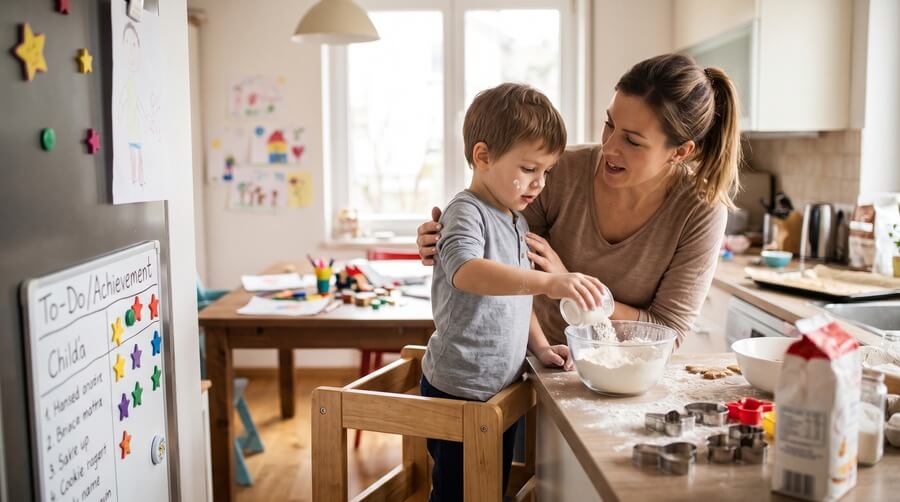
My middle child is incredibly shy, but we discovered he has an absolute obsession with baking. We started setting aside time on Sunday afternoons just for him to bake muffins. Watching him measure ingredients and proudly serve his creations to the family completely transformed his posture. He stands taller now because he knows he is an “expert” at something.
Pay attention to what naturally draws your child’s interest, and give them the time, space, and resources to dive deep into it.
Final Thoughts on the Journey
Confidence building for kids isn’t a one-time project; it’s a slow, beautiful journey made up of hundreds of tiny, everyday interactions. It’s about creating a safe landing pad at home so that when they finally step out into the big, wide world, they know exactly who they are and what they are capable of.
They won’t always get it right, and neither will we as parents. But as long as we keep showing up with grace, patience, and a whole lot of love, they are going to be just fine.
Let’s Chat in the Comments! 👇
I would absolutely love to hear from you. We are all in this parenting village together!
- What is one thing your child is incredibly proud of right now?
- Have you ever struggled with letting your kids make mistakes? How did you handle it?
- Drop a comment below and share your own tips for building confidence at home!