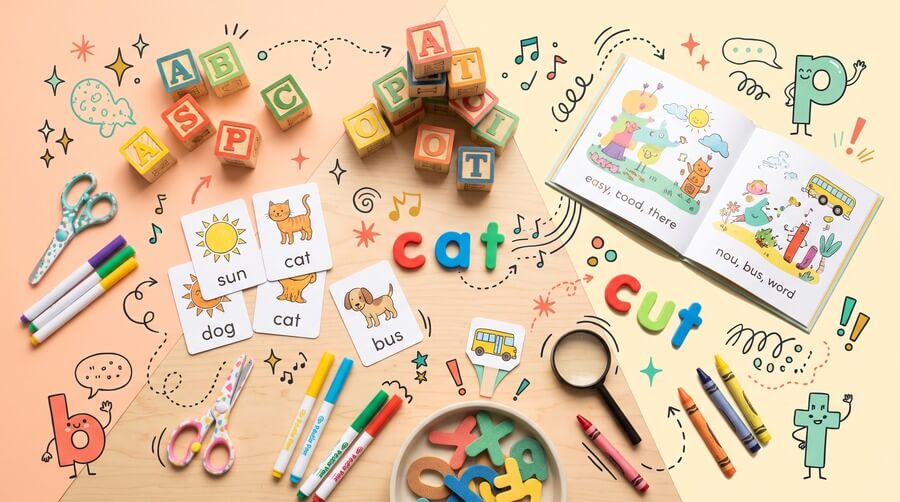
I still remember the day I tried to teach my little one their first letter sounds. I sat there with a standard workbook, pointing at a letter “A” and making the “ah” sound, expecting a lightbulb moment. Instead, I got a blank stare, a dramatic sigh, and a toddler who suddenly needed to be anywhere else in the house.
It hit me right then: kids don’t want to be lectured; they want to play. If I wanted to raise an enthusiastic reader, I had to stop treating reading like a chore and start treating it like a game.
That shift in perspective changed everything in our house. When we moved away from boring drills and embraced hands-on phonics activities preschool style, learning to read became something we actually looked forward to. If you are in the thick of teaching early literacy, take a deep breath. You don’t need a teaching degree—you just need a little creativity.
Here are some of the most effective, stress-free, and incredibly fun phonics games that worked wonders for my family.
1. The “Sound Scavenger Hunt”
Kids love a mission. Instead of asking your child to simply say the sound for the letter “B,” hand them a basket and tell them they are on a “B-Hunt.” How to play: Say, “We are looking for things that start with the buh sound.” Let them run around the house collecting a ball, a book, a banana, and a block. When they bring the basket back, go through the items together and emphasize the starting sound. It gets them moving and connects abstract letter sounds to the real, physical world they interact with every day.
2. Playdough Letter Stamping
There is something magical about sensory play that just makes information stick in a child’s brain. How to play: Roll out some playdough on the kitchen table. Use plastic alphabet magnets or alphabet cookie cutters to stamp letters into the dough. As your child presses a letter down, have them say the sound it makes (not just the name of the letter). If they stamp a “C,” they say “kuh.” It’s a brilliant way to build fine motor skills while reinforcing their phonics knowledge.
(Love hands-on play? Your little one will also enjoy these easy and fun DIY Alphabet Crafts for Preschoolers!)
3. The Sticky Note Sound Wall
This is an absolute favorite because it gives kids permission to do something they usually aren’t allowed to do: throw things at the wall. How to play: Write different letters on sticky notes and put them up on a blank wall or a glass door. Give your child a rolled-up pair of soft socks or a lightweight foam ball. Call out a phonetic sound (like “mmmm”) and have them throw the ball at the corresponding letter (M). It’s active, hilarious, and brilliant for developing quick sound-to-letter recognition.
4. Bathtub Phonics Fishing
Why not use bath time for a little stealthy learning? How to play: Toss a handful of foam bath letters into the tub. Give your child a small plastic slotted spoon or a toy fishing net. Ask them to “fish” for the letter that makes the “sss” sound. When they scoop up the “S,” they get to stick it to the wet bathroom tiles. Before you know it, the bath is over, and they’ve practiced a dozen sounds without realizing they were doing anything but playing.
5. Flashcards with a Twist (Plus a Free Gift!)
Flashcards get a bad reputation because adults tend to use them like strict quizmasters. But when used as playing cards, they are incredibly effective. We use flashcards to play “Phonics Jump.” I lay them out on the floor like stepping stones. To get across the “lava” (the living room rug), my child has to step on a card and shout its sound.
Tip For Busy Parents: I know you don’t always have time to create your own materials. That is why I’ve put together a set of Free Downloadable Phonics Flashcards just for you! They are colorful, easy to read, and perfect for games. Click here to download your free flashcards, print them out (I recommend laminating them so they survive sticky fingers!), and start playing today.
6. Nature Walk Sound Matching
Getting outside is a great reset button for a cranky kid (and a tired parent). How to play: Grab a piece of cardboard and write 3-4 letters on it. Take a walk around your neighborhood or backyard and look for items in nature that start with those sounds. A leaf for “L,” a rock for “R,” and a stick for “S.” Tape the items right onto the cardboard next to the letter.
7. Shaving Cream Spelling
Warning: this one gets messy, but it is worth it. How to play: Spray a pile of cheap shaving cream onto a baking sheet or right onto your kitchen counter. Let your child spread it around, and then call out a letter sound. Have them use their pointer finger to write the letter in the shaving cream. The tactile feedback helps cement the shape of the letter in their mind, connecting the physical motion to the auditory sound.
8. Snack Time Phonics
Everything is more motivating when snacks are involved. How to play: If you are serving alphabet crackers, cereal, or even alphabet soup, have your child identify the sound of the letter before they eat it. “Ooooh, you found a T! What sound does T make? Tuh! Okay, gobble it up!”
9. Musical Letter Chairs
A perfect game if you have more than one child, or if you want to invite some preschool friends over. How to play: Place a few letter flashcards in a circle on the floor. Play some fun, upbeat music and have the kids walk around the circle. When the music stops, they freeze and stand on a card. Go around the circle and have each child yell out the sound of the letter they landed on.
10. Bedtime Story Sound Spotting
You are already reading to them every night, so why not add a tiny sprinkle of phonics practice? How to play: While reading their favorite bedtime story, pick a “magic sound” for the night. Let’s say it’s the “puh” sound. Every time they hear you read a word starting with that sound, they get to tap the book or clap their hands. It builds critical active listening skills.
(Want to build their language skills even more? Check out my guide on How Storytelling Boosts Your Child’s Vocabulary!)
A Final Note on Early Literacy
The most important thing I’ve learned on this journey is to follow my child’s lead. If they are tired, frustrated, or simply not interested, we stop. The phonics activities preschool kids enjoy most are the ones that feel like pure play. Keep the sessions short—just five to ten minutes is plenty at this age!
Celebrate the small wins, laugh at the funny mistakes, and remember that every child learns at their own beautiful, unique pace. You are doing a great job, and by simply engaging with them, you are laying a foundation for a lifelong love of reading.
Let’s Chat! (Over to You)
I absolutely love hearing what works in other homes!
- Which of these activities do you think your little one would enjoy the most?
- Do you have a creative phonics game that has worked wonders for your family?
- What is your biggest struggle when it comes to teaching early reading?
Drop a comment below and let me know—I try to reply to every single one!