If you have ever watched a toddler struggle to remember where they put their shoes, yet recite every single word to a two-minute cartoon theme song without missing a beat, you have already seen music learning kids magic in action.
In my own home, homework time used to feel like an uphill battle. Getting through basic spelling lists or multiplication tables meant endless sighs, fidgeting, and distraction. Out of sheer desperation one afternoon, I turned on a soft instrumental playlist in the background and started turning spelling words into silly, rhythmic chants. Within a week, not only did the complaints stop, but retention shot way up.
It turns out, that was not just a lucky parenting hack. Neuroscience and child development research show that music is one of the fastest, most natural ways to wire a young brain for learning.
Why Music Learning Kids Strategies Supercharge a Child’s Brain
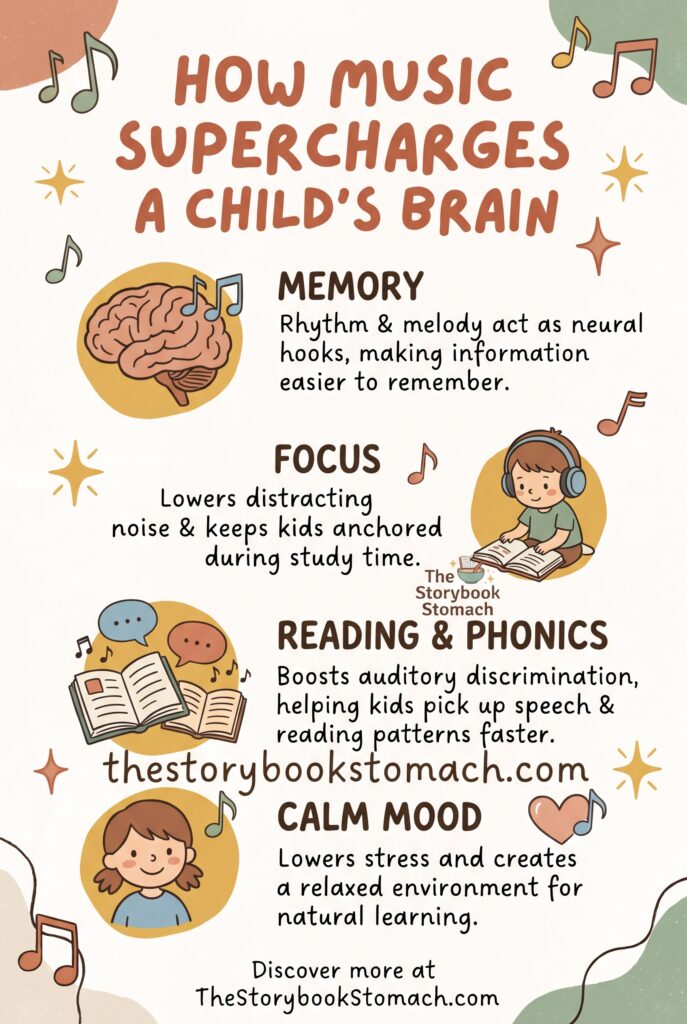
When children listen to music, sing along, or tap a beat, their brains do not just process sound—they light up across multiple regions at once. Unlike passive screen time, music activates areas responsible for memory, language, motor skills, and emotional regulation simultaneously.
1. Music Builds Stronger Neural Pathways
Research shows that musical exposure strengthens the corpus callosum—the bridge of nerve fibers connecting the left and right hemispheres of the brain. When both sides of the brain communicate faster and more efficiently, children get better at creative problem-solving, pattern recognition, and critical thinking.
2. Rhythm Locks Information Into Long-Term Memory
There is a reason almost every culture teaches the alphabet through a melody. Rhythm and melody act like hooks for the brain. Studies on cognitive development highlight that rhythmic structure helps children organize information into predictable chunks, making facts, sequences, and vocabulary much easier to store and recall later.
3. Better Listening Means Faster Reading and Language Skills
Before children can read words on a page, they have to hear the tiny differences between sounds—a skill known as auditory discrimination. Longitudinal studies show that children exposed to musical training become significantly better at picking out subtle pitch and syllable changes. That fine-tuned ear translates directly into stronger phonics, clearer speech, and faster reading comprehension.
4. Music Lowers Stress and Extends Focus
A stressed or anxious brain cannot absorb new information effectively. Calm, steady background music lowers cortisol levels and helps kids regulate restless energy. Instead of fighting against distraction, a gentle acoustic or lo-fi track gives a wandering mind just enough stimulation to stay anchored on a worksheet or storybook.
Practical Ways I Use Music for Everyday Learning
You do not need expensive private violin lessons or a background in music theory to get these benefits at home. Here are the simplest routines that have worked wonders for us:
Download Free Printable: Kids’ Daily Music & Study Checklist (PDF)
- Turn Tough Facts Into Jingles: Struggling with days of the week, phone numbers, or skip-counting? Put the words to the tune of “Twinkle, Twinkle, Little Star” or “Row, Row, Row Your Boat.”
- Use “Transition Songs” for Daily Routines: Instead of repeating “clean up your toys” five times, play one specific upbeat song. Kids quickly associate that three-minute track with tidy-up time, turning a chore into a beat-the-clock game.
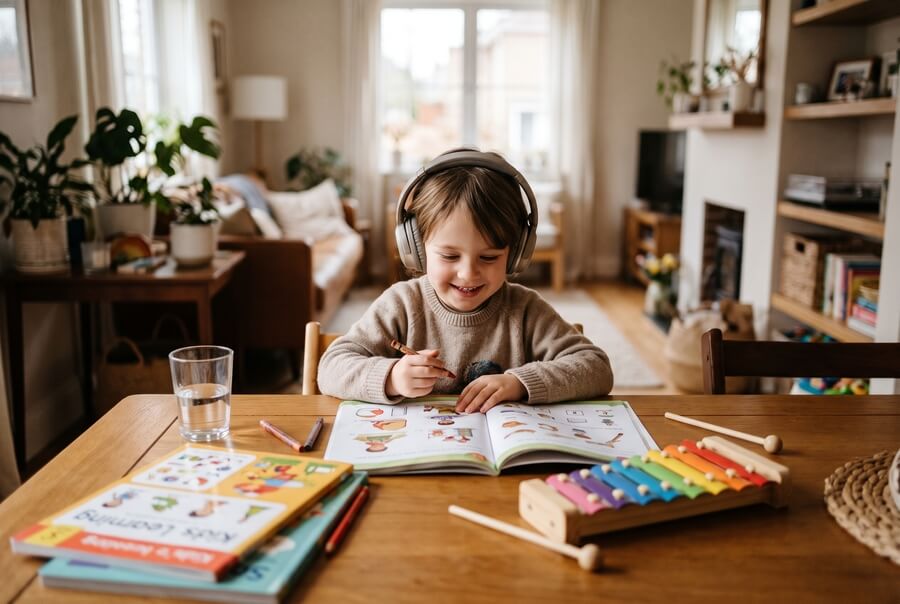
- Keep a Basket of Simple Instruments Nearby: Shakers, tambourines, or even a wooden spoon and a pot let younger kids clap out syllables in new words—a fantastic hands-on phonics trick.
- Keep Lyrics Off During Reading and Math: While sing-alongs are amazing for vocabulary and memory, lyrics compete with the brain’s language center during reading or math homework. Switch to wordless instrumentals when deep focus is needed.
Best Spotify Playlist Ideas for Kids’ Learning
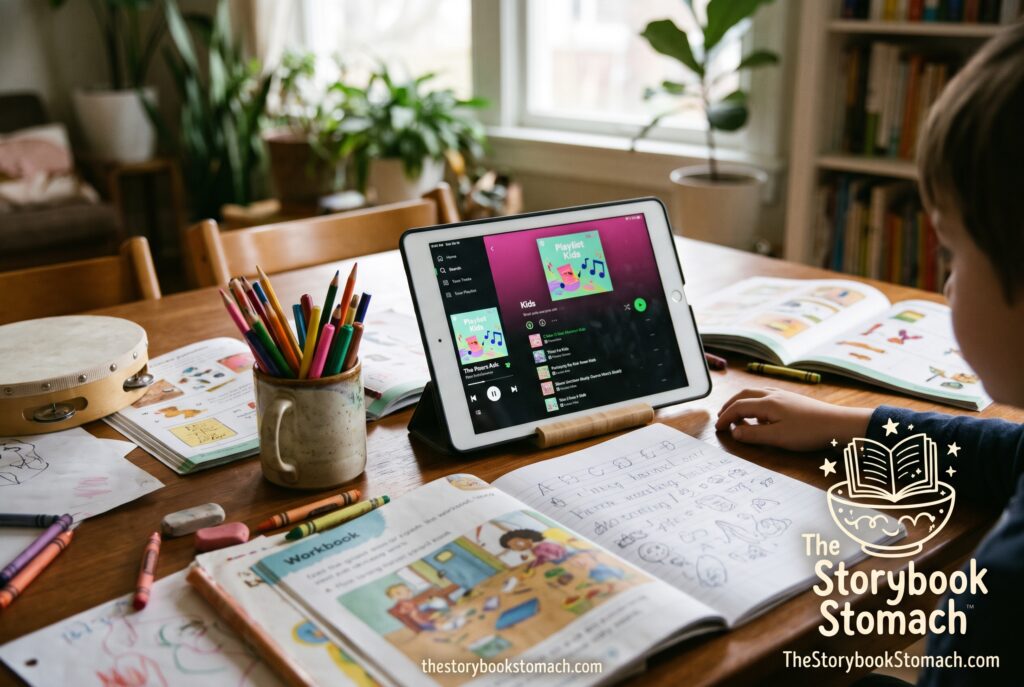
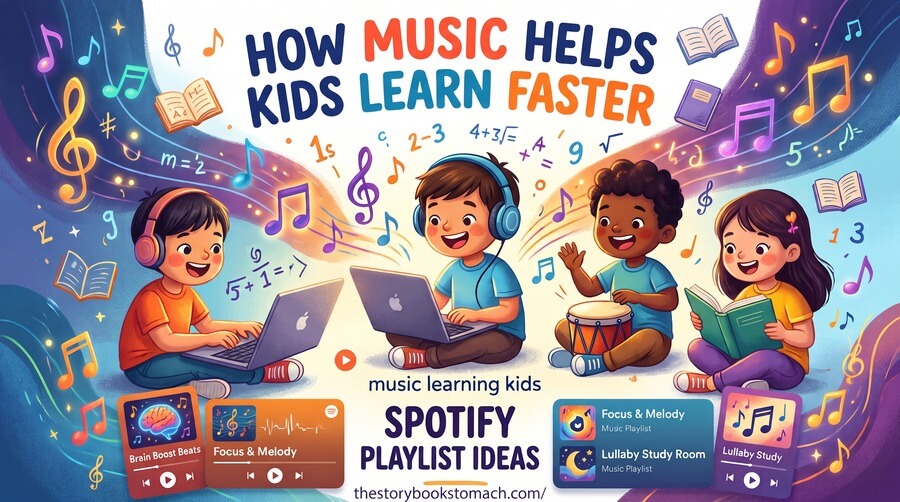
One of the easiest ways to start is by saving a few dedicated playlists on Spotify for different parts of the day. Here are four styles to search for and try:
1. Instrumental Lo-Fi & Study Beats (Best for Homework & Reading)
Look for playlists like “Kids Study Music: Focus and Concentration” or gentle lo-fi beats. The steady, predictable tempo blocks out household noise without distracting your child with lyrics.
2. Classical & Baroque for Kids (Best for Puzzles & Math)
Search for “Study with Mozart” or “Classical Music for Kids”. Composers like Mozart, Bach, and Vivaldi use structured mathematical patterns in their melodies that naturally complement spatial reasoning and math practice.
3. Educational Sing-Alongs (Best for Toddlers & Preschoolers)
Playlists packed with phonics songs, counting rhymes, and action tracks (like “Freeze Dance” or “Head, Shoulders, Knees and Toes”) build early literacy, balance, and listening skills during morning playtime.
4. Nature & Acoustic Lullabies (Best for Wind-Down & Bedtime Stories)
Search for “Ocean Piano Lullabies” or “Calm Piano Music for Study Time”. Playing soft piano while reading aloud before bed helps children relax and absorb new vocabulary right before sleep consolidates their memory.
Quick Checklist Before You Hit Play
- Watch the volume: Keep background study music low—around the volume of a quiet conversation.
- Let your child pick sometimes: Giving kids a choice between two instrumental playlists gives them a sense of control and buy-in.
- Match the tempo to the task: Upbeat rhythms for movement and memory games; slow, steady instrumentals for writing and reading.
Let’s Chat in the Comments!
I would love to hear how music fits into your family’s daily routine:
- What is one song or jingle your child memorized effortlessly—even faster than their schoolwork?
- Have you ever tried playing instrumental music during homework time, and did it help your kids focus?
- What is your family’s go-to Spotify playlist or kids’ artist right now?
Drop your favorites in the comments below—I am always looking for new playlists to add to our rotation!